Xanthos and Letoon belong together in a heritage itinerary, but they are not one attraction behind one entrance. A rental car can connect the two visits from Dalaman while leaving you free to choose their order and duration. The main planning task is to protect enough time for both sites, not to add as many nearby coastal stops as possible. Check each gate, each ticket arrangement and the return drive separately before treating a combined name on a map as a complete day plan.
Understand what links the two places
UNESCO lists Xanthos-Letoon as a shared World Heritage property associated with ancient Lycia. Its account highlights the interaction of Lycian and Hellenic traditions and the importance of surviving inscriptions. That shared historical context explains why visiting both can be rewarding. It does not mean that the modern visitor entrances, opening hours or admission products are identical.
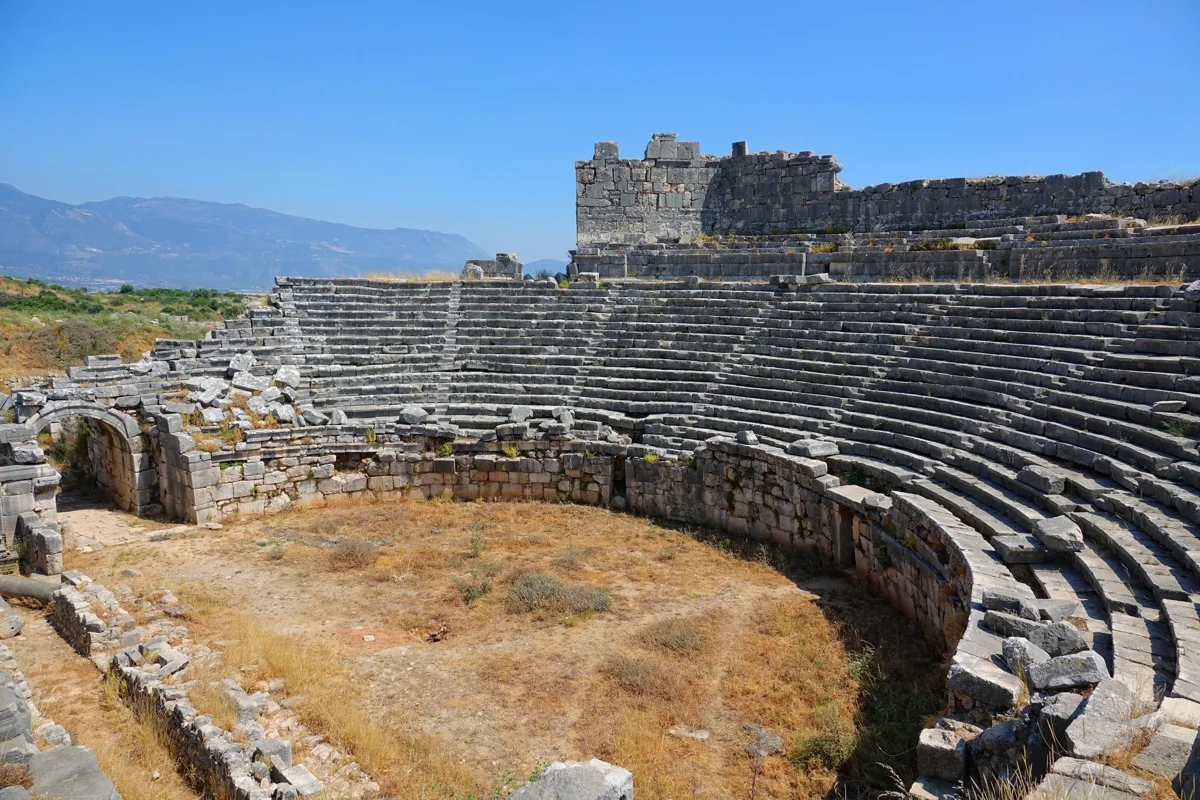
Xanthos offers the setting of an ancient city, including the theatre visible in this guide's archival photograph. Letoon is the sanctuary associated with Leto, Apollo and Artemis in the Turkish museum authority's description. Keep those identities distinct when deciding what interests your group. A traveller drawn to the theatre may allocate time differently from someone primarily interested in the sanctuary and its religious context.
Before setting out, save two named destination pins. Label them clearly in the order you intend to visit and include the actual return point as a third destination. This simple separation prevents an easy mistake: navigating to one site and assuming that the other is merely another section to find after walking through the same ticket gate.
Use the earlier closing site to shape the day
On 8 November 2026, the official Xanthos listing showed opening 08:00–17:00 with the ticket office closing 16:30. Letoon's official listing showed 08:30–18:00 with the ticket office closing 17:30. Check the current listings and any date-specific notice before travelling. These are the published times reviewed for this guide, not a guarantee that an unexpected closure or operating change cannot occur.
For a two-site day, visiting Xanthos first can be a useful planning choice because its listed closing time is earlier. That is an itinerary suggestion, not a rule or an assurance about the best traffic route. If your accommodation, an arranged guide or a confirmed booking makes the reverse order preferable, work backwards from the earlier gate deadline before committing to it.
Do not use last ticket sale as your intended arrival. Admission near the end of the day may leave little meaningful time to walk, read information and return to the exit. Set your own earlier arrival target and identify which visit you will shorten or omit if the drive takes longer than expected. Avoid turning a missed first stop into two rushed stops.
Separate Dalaman collection from departure on the road
If you are collecting the car at Dalaman Airport, allow for the complete handover before starting the heritage itinerary. A flight arrival, rental appointment and actual road departure are three different moments. Confirm the meeting point, check the vehicle and resolve documentation questions before allowing a museum deadline to pressure the collection process.
If you already have the car at accommodation, plan from that address rather than using an airport journey estimate. Check the current route to the chosen first entrance and allow a suitable rest stop. This guide does not promise an exact driving duration or describe every junction as permanently unchanged. Use current navigation for the road and official museum information for the attraction.
The Dalaman to Kas guide is useful when this visit forms part of a wider move along the coast. Decide whether Xanthos and Letoon are the purpose of a return day or stops before an overnight stay elsewhere. Those two plans have different luggage, daylight and rental-return implications, even if the first part of the road journey looks similar.
Choose a rental for the whole itinerary
Compare the Dalaman car catalogue using the real collection and return times, passenger count and luggage. An ordinary road trip to archaeological sites does not by itself require an off-road vehicle. What matters is a car the driver handles comfortably, enough space for the group and equipment confirmed for the actual booking. Do not treat ground clearance as permission to leave permitted roads.
Check the vehicle-specific mileage allowance against both intercity legs and the connection between the sites. Include any accommodation transfer you have already planned. If the itinerary depends on sharing the driving, arrange the additional driver under the supplier's conditions before departure. A passenger's willingness to help is not the same as contractual permission to drive the car.
Review payment and security separately. The Dalaman rental insurance guide explains the questions to ask about cover, but an attraction visit does not change the selected offer's exclusions or excess. Ask about anything unclear before paying, including the accepted payment method at collection and the agreed fuel policy. Do not rely on a general destination slogan as the terms of your booking.
Plan parking and walking at each entrance
Use the signed visitor arrival arrangement at each site and follow staff instructions. The presence of a parking area in an official facilities listing does not establish a free reserved space, a particular surface or permission to stop beside every monument. Check where the vehicle may remain before the group walks away, especially if you arrive during an event or temporary access change.
Take the items you need for the walking visit from the car: water, sun protection, suitable footwear and necessary medication. Archaeological sightseeing is not a drive-through activity. Do not leave someone depending on air conditioning in an unattended vehicle while others explore. Choose a visit length that works for every passenger rather than treating the parked car as an alternative waiting room.
Before crossing into the second site, repeat the arrival check rather than assuming the first site's arrangements carry over. A different entrance can mean different walking surfaces, a different distance from parking and a different payment procedure. Photograph the parking location if useful, secure the key and keep valuables out of view; no historical-site ticket protects belongings left in the car.
Give Xanthos a clear focus instead of a checklist
At Xanthos, start by orienting yourself using the information available at the entrance. Identify the areas currently open to visitors and choose a route that the group can complete comfortably. The theatre is a useful visual anchor, but an archival photograph is not evidence that every stair, seating tier or adjacent structure may be entered today. Respect barriers and the route in place.
Choose a small number of questions to guide the visit: how the settlement is laid out, how its public spaces relate to each other, or what the inscriptions and monuments reveal about the people who used it. Read site interpretation rather than relying on an unattributed social-media caption. You do not need to invent a dramatic story for each stone to make the visit worthwhile.
Keep a departure time in mind, but do not spend the whole visit watching it. Agree a meeting point before members of the group separate, then leave a short interval for getting everyone back to the car. The next driving leg starts only when the group has returned, packed and checked the next destination, not at the instant one person finishes looking around.
Let Letoon be a different visit, not a repeat photograph stop
At Letoon, the sanctuary context provides a different way to look at the landscape after the urban setting of Xanthos. Use the official interpretation to distinguish the remains associated with the different deities rather than treating every foundation as part of the same building. The museum authority also describes a theatre and other remains, so allow time to understand the layout rather than heading straight back to the car after one view.
Ask which paths and areas are currently accessible if the ground or weather makes the route unclear. This guide does not certify dry surfaces, step-free circulation or an unobstructed route through the entire site. A visitor with limited mobility should ask about the particular entrance-to-feature journey before travelling, not infer accessibility from a parking icon or a wide-angle photograph.
Keep the shared historical story in mind without forcing both sites into identical visits. If the first stop was long and detailed, the second can be a shorter, focused exploration. If Letoon is the main interest, allocate it the greater share of the day from the start. The value of combining the sites comes from the contrast, not from spending exactly the same number of minutes at each.
Check admission products without assuming a joint ticket
Before buying, establish what the selected ticket or museum pass covers at each named site on your visit date. Shared UNESCO status is not a ticketing policy. Check eligibility rules, validity dates and whether any particular area or activity is separate. This guide deliberately avoids a universal combined price because a misleading total is less useful than knowing which two admissions to verify.
For the budget, record the confirmed admission amounts alongside the rental cost, estimated fuel and any parking charge. Keep optional guiding, food and equipment separate. If one person qualifies for a concession, check what evidence is required and whether the same rule applies at the other site. Do not assume that a discount at the first entrance automatically transfers to the second.
Retain the relevant confirmations until the visits are complete. If a pass fails to scan or a ticket appears not to cover an area, ask staff to clarify before purchasing another product. A screenshot of a general promotional page is not necessarily the ticket itself. Keep the booking reference and the date visible when asking about your own admission.
Avoid turning this into a rushed Patara, Kas and ruins circuit
Nearby destinations can make an itinerary look temptingly efficient on a map. In practice, each adds a vehicle arrival, parking, walking and departure. The Patara driving guide describes a separate archaeological-and-beach visit; it should not be treated as an automatic extra after two sites simply because it lies in the same wider region.
Choose one of three clear plans: a two-site return day from Dalaman, one priority site followed by an overnight move, or separate days for the heritage pair and the coast. Use the current road estimate and the passengers' interests to decide. A late start or shorter winter day may favour the simpler plan even when a summer itinerary found online looks more ambitious.
If the weather or the group's energy changes, remove an optional stop before compromising the return. Eating and resting are part of the itinerary, not empty time between attractions. Do not add an unfamiliar unpaved shortcut to recover a timetable; both road safety and the rental agreement matter more than completing the original list of names.
Finish with a realistic return to Dalaman
Before leaving the final site, check the current route to the actual overnight or handback location. Set navigation while parked. If the car is due back, include the required fuel level, unloading and the supplier's inspection procedure. An airport entrance pin is not necessarily the agreed rental meeting point, so keep the supplier's directions available separately.
If you expect to miss the confirmed return time, contact the supplier through the booking's verified channel before that time and request an approved change. Do not assume that buying another museum ticket, staying for sunset or encountering a delayed departure automatically extends the rental. Keep the response and follow the agreed arrangements for the car and keys.
Xanthos and Letoon make a coherent pair because their histories connect while their visitor experiences differ. A good driving plan preserves that distinction: two entrances, two walking visits and one considered mainland route. Leave enough room for the return so the day's final memory is the heritage you explored, not a rushed handover at the end of an overfilled itinerary.
Questions & answers
Are Xanthos and Letoon one entrance?
No. Plan two separate arrival points and visits, even though UNESCO lists them together.
Which site should I visit first?
The reviewed Xanthos schedule closes earlier, so visiting it first can be practical. Check current hours, your starting point and any booked arrangements before choosing the order.
Does one ticket automatically cover both sites?
Do not assume that. Check the exact admission product or pass coverage for each site and your visit date.